Redis 命令执行流程

redis 服务端接受客户端发送过来的命令,通过事件分发机制将对应的命令分发到不同的执行函数,由各具体的执行函数执行对应命令
1、主流程
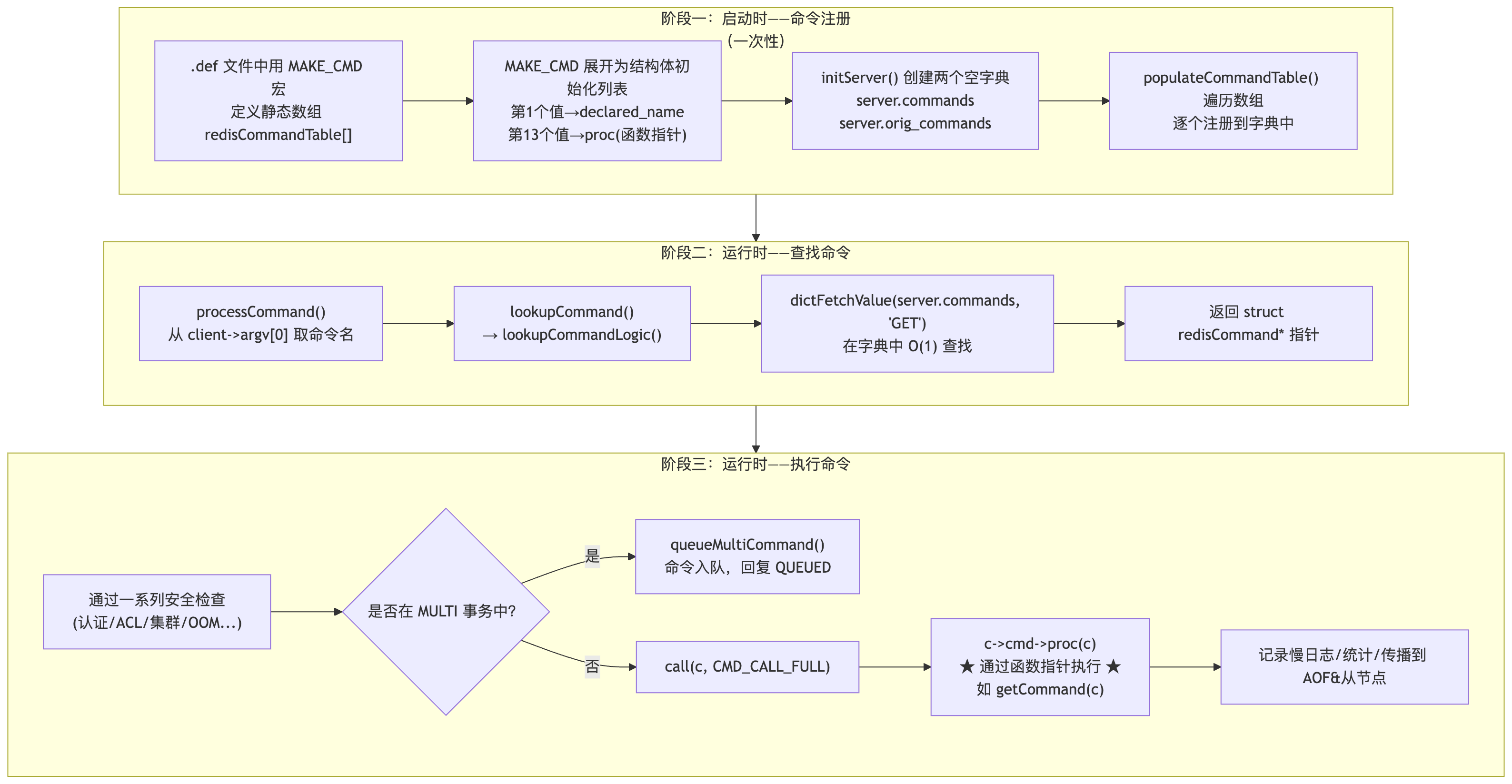
分为三个阶段:
1、启动时,将 .def 文件中包含的命令信息加载到内存中,以数组形式存放。
2、运行时,接受客户端发送过来的命令,在完成网络 io 和事件分发后,在 processCommand 中调用 lookupCommand 查询对应命令的 redisCommand 结构体。事件分发实现详见:xxx
3、执行命令,在 processCommand 中,执行完一系列检查后调用 call,执行 c->cmd->proc(c),真正走到实现命令的函数中。
这里的整个核心设计思想:
Redis 利用 函数指针 + 哈希表 实现了一个高效的命令分发系统。所有命令在编译时就通过宏定义绑定了名称和处理函数,启动时注册到字典中,运行时通过 O(1) 的字典查找定位到命令结构体,再通过函数指针直接调用——整个过程没有任何 if-else 或 switch-case 分支判断,极其高效。
2、命令注册
2.1 命令是怎么组织的
所有的命令相关的信息都通过静态数组定义(编译时),这些信息都存在 command.def 文件中。 在 commands.def 中,所有 Redis 命令被定义为一个静态数组:
struct redisCommand redisCommandTable[] = {
    {MAKE_CMD("get", "Get the value of a key", "2.0.0", ..., getCommand, ...)},
    {MAKE_CMD("set", "Set the string value of a key", "1.0.0", ..., setCommand, ...)},
    // ... 数百个命令 ...
    {0}  // 哨兵元素,标记数组结束
};

struct redisCommand {
    const char *declared_name; // 命令名字
    const char *summary;	// 概览
    const char *complexity; // 时间复杂度
    const char *since; // 版本
    int doc_flags;
    ...
    redisCommandProc *proc; /* Command implementation */
    struct redisCommand *subcommands;
    struct redisCommandArg *args;
    sds fullname; /* A SDS string representing the command fullname. */
    dict *subcommands_dict;
};
MAKE_CMD 宏展开后,每个元素按字段顺序初始化 struct redisCommand 结构体,其中: 第 1 个值 → declared_name 字段(命令名,如 “get”) 第 13 个值 → proc 字段(函数指针,如 getCommand) 这意味着命令名和处理函数在编译时就已经绑定好了,此时所有命令的对应的信息都写到了 redisCommandTable 数组中了,相当于 redisCommandTable 数组被赋值了。
2.2 函数调用:
在 server.c 的 main 函数中:
main() -> initServerConfig() -> populateCommandTable()
populateCommandTable() 函数的作用是:
遍历一个静态的命令数组 redisCommandTable[],把每个命令注册到 server.commands 和 server.orig_commands 这两个字典(dict/哈希表)中,以便后续通过命令名快速查找到对应的命令结构体
extern struct redisCommand redisCommandTable[];

/* Populates the Redis Command Table dict from the static table in commands.c
 * which is auto generated from the json files in the commands folder. */
void populateCommandTable(void) {
    int j;
    struct redisCommand *c;

    for (j = 0;; j++) {
        c = redisCommandTable + j;	// 指针算术,等价于 &redisCommandTable[j]
        if (c->declared_name == NULL) // 遇到哨兵元素,结束
            break;

        int retval1, retval2;

        c->fullname = sdsnew(c->declared_name);	// 转为string sds形式
        if (populateCommandStructure(c) == C_ERR)
            continue;
				// 以命令名为 key,redisCommand* 为 value,插入字典(server.commands, server是一个全局变量)
        retval1 = dictAdd(server.commands, sdsdup(c->fullname), c);
        /* Populate an additional dictionary that will be unaffected
         * by rename-command statements in redis.conf. */
        retval2 = dictAdd(server.orig_commands, sdsdup(c->fullname), c);
        serverAssert(retval1 == DICT_OK && retval2 == DICT_OK);
    }
}
注册后,内存结构类似于下图:
server.commands (dict 哈希表)
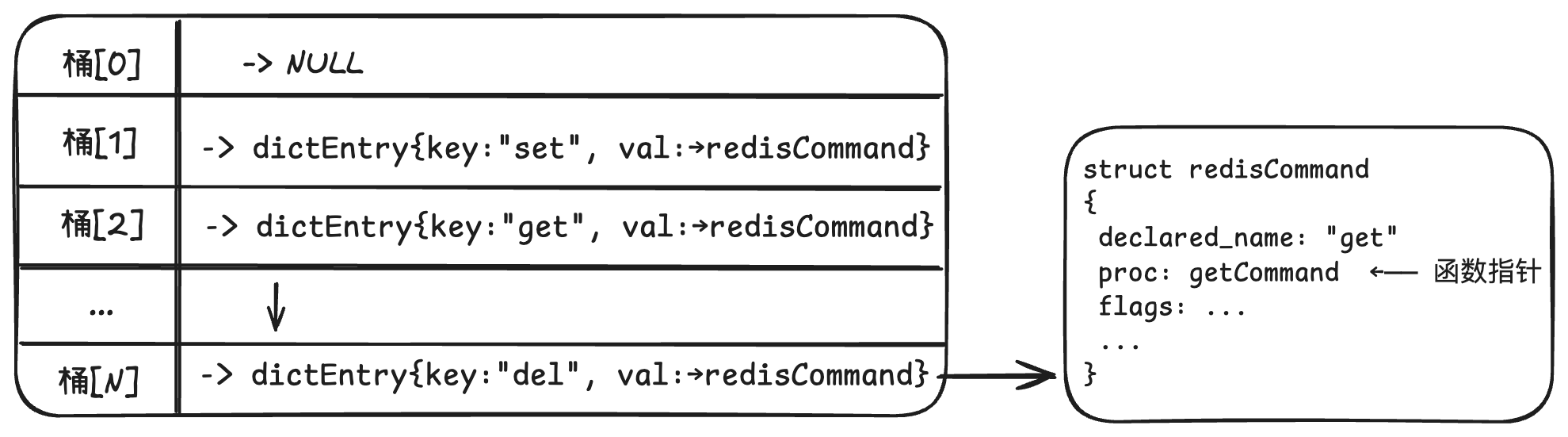
具体的 dictAdd 就是寻找插入位置,根据哈希函数得到 key 的哈希值,然后对数组桶进行索引,得到桶位置,再挂在对应桶的链表中。采用的是链表头插法。
3、查找命令
当客户端发来 GET key1 时,在 processCommand() 中会执行 cmd = lookupCommand(c->argv, c->argc)
而 lookupCommand() → lookupCommandLogic():
/* Look up a command by argv and argc
 *
 * If `strict` is not 0 we expect argc to be exact (i.e. argc==2
 * for a subcommand and argc==1 for a top-level command)
 * `strict` should be used every time we want to look up a command
 * name (e.g. in COMMAND INFO) rather than to find the command
 * a user requested to execute (in processCommand).
 */
struct redisCommand *lookupCommandLogic(dict *commands, robj **argv, int argc, int strict) {
    struct redisCommand *base_cmd = dictFetchValue(commands, argv[0]->ptr);
    int has_subcommands = base_cmd && base_cmd->subcommands_dict;
    if (argc == 1 || !has_subcommands) {	// 判断是不是还有子命令
        if (strict && argc != 1)
            return NULL;
        /* Note: It is possible that base_cmd->proc==NULL (e.g. CONFIG) */
        return base_cmd;
    } else { /* argc > 1 && has_subcommands */
        if (strict && argc != 2)
            return NULL;
        /* Note: Currently we support just one level of subcommands */
        return lookupSubcommand(base_cmd, argv[1]->ptr);
    }
}

struct redisCommand *lookupCommand(robj **argv, int argc) {
    return lookupCommandLogic(server.commands,argv,argc,0);
}
底层 dictFetchValue() 的查找过程:
1、用大小写不敏感的哈希函数(dictSdsCaseHash)计算 “GET” 的哈希值
2、对哈希表大小取模,定位到桶索引
3、遍历桶中的链表,用大小写不敏感比较(dictSdsKeyCaseCompare)匹配 key
4、找到后返回 dictEntry->val,即 struct redisCommand * 指针
4、执行命令
if (c->flags & CLIENT_MULTI && /* 在事务中且不是 EXEC/DISCARD 等 */) {
    queueMultiCommand(c, cmd_flags);  // 入队等待 EXEC
    addReply(c, shared.queued);       // 回复 "+QUEUED"
} else {
    call(c, CMD_CALL_FULL);           // 正常执行
}
call 函数:
void call(client *c, int flags) {
    dirty = server.dirty;                  // 记录执行前脏数据计数
    monotonic_start = getMonotonicUs();    // 记录开始时间

    c->cmd->proc(c);                      // 核心:通过函数指针调用
    //  GET → getCommand(c)
    //  SET → setCommand(c)

    duration = getMonotonicUs() - monotonic_start;  // 计算耗时
    real_cmd->calls++;                              // 更新调用次数统计
    // ... 慢日志 / AOF 传播 / 从节点同步 ...
}
为什么执行 c->cmd->proc(c) 能够找到正确的函数执行?
这是因为 getCommand 这个函数指针是作为 MAKE_CMD 宏的第 13 个参数(function)传入的,宏展开后它成为结构体初始化列表中的第 13 个值,正好对应 redisCommand 结构体的 proc 字段。
所以当 Redis 执行 c->cmd->proc(c) 时,实际调用的就是 getCommand(c)。在 .def 文件中看到的 getCommand 不是"命令名字",它是真正的 C 函数名,在编译时被当作函数指针赋给了 proc 字段,即函数的起始地址赋给了 proc 字段。
函数类型 redisCommandProc 的定义是:
typedef void redisCommandProc(client *c);getCommand 的签名完全匹配
void getCommand(client *c);